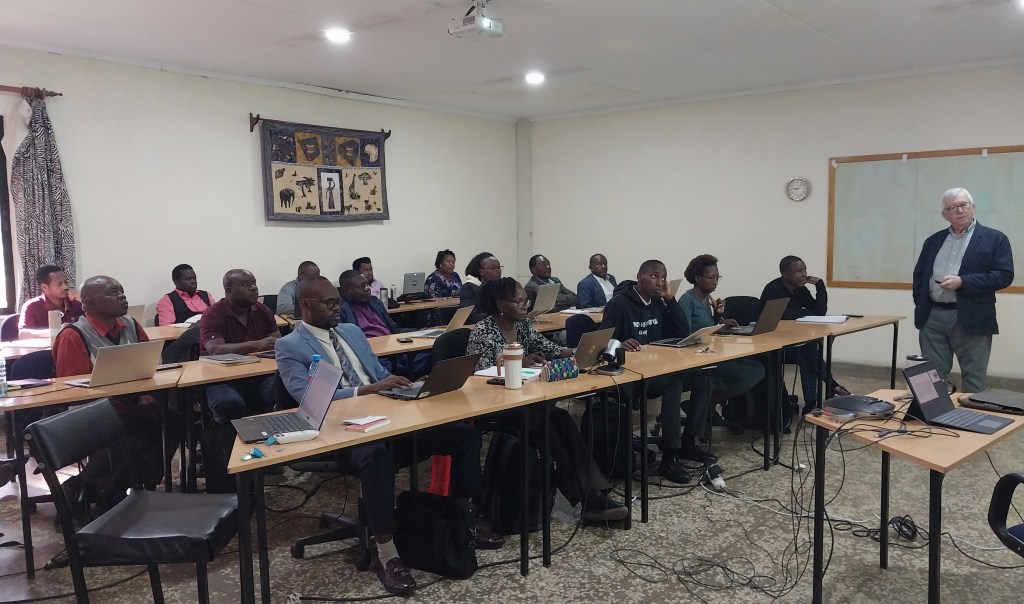
Over the past two weeks, from January 13th to 24th, a series of lectures were delivered by Professor Mark Shaw from Africa International University and guest lecturer Dr. Kyama Mugambi from Yale University. During the first week, four students participated in a seminar on Pentecostalism, co-taught by the two lecturers. In the second week, Professor Shaw lectured on Key Concepts in World Christianity to nineteen students from various countries, including Kenya, Uganda, Ethiopia, the Democratic Republic of Congo, and South Africa.
Week One: Global Pentecostalism (Jan. 13th-17th)
The first week was packed with soul-strengthening morning devotions where Professor Mark Shaw took the students on the journey on The Charismatic Spirituality of Teresa of Avila emphasising personal transformation through beholding the glory of Christ, as highlighted in 2 Corinthians 3:18. This privilege, unlike Moses’ veiled experience, allows believers to be transformed into Christ’s image from one degree of glory to another through the Spirit’s power. Spiritual growth is further emphasized in John 15:5, Ephesians 3:17-19, and Romans 8:38-39, focusing on making a home in Christ, being rooted in love, and filled with God’s fullness. The ultimate intimacy with God is described in the 7th mansion, inspired by Song of Solomon 7:10-12, representing a spiritual union with the Trinity and a profound integration of mind, body, and spirit in Christ, fulfilling Galatians 2:20. Teresa’s unique vision of the Trinity, as Shaw explained, reveals a deep understanding and communication with all three Persons. The seventh mansion also signifies a time of freedom to follow Jesus into others’ lives, sharing God’s love and inviting others to Him. John Owen’s reflections on beholding Christ’s glory, as Shaw put it, stress that this is a believer’s greatest privilege, leading to transformation and eternal enjoyment. This involves reflecting on Christ’s excellencies, His person as fully God and man, His humility, mediatory work, exaltation, union with the Church, and role in restoring all things. Shaw explained that John 15:5 underscores the importance of abiding in Christ to bear fruit, encouraging believers to long for the vision, depend on the Spirit, confess laziness and worldliness, focus on the Word, pray for the vision, and share the longing with others. These devotions urged the PhD students who were present to reflect on their current spiritual state, aspire to deeper intimacy with God, and actively pursue this through prayer, scripture, and community.
Teresa’s unique vision of the Trinity, as Shaw explained, reveals a deep understanding and communication with all three Persons.
These devotions were followed by lectures on Global Pentecostalism where Dr. Kwama Mugambi reminded the students of Pentecostalism that has become a significant religious movement in Sub-Saharan Africa, often referred to as an “African Reformation” due to its profound impact on African Christianity. Lagos, Nigeria, was highlighted as the most Pentecostal city globally, with a rich history of independent African churches emphasizing spiritual gifts. The term “Pentecostal”, as Dr. Kyama explained, encompasses various African churches that focus on the Holy Spirit’s work, including prophecy, speaking in tongues, healing, and exorcism. The movement includes African-initiated churches, classical Pentecostal churches of Western origin, progressive Pentecostal, and new Charismatic churches. Pentecostalism has seen rapid growth in countries like Zimbabwe, Kenya, Ghana, Nigeria, the Democratic Republic of the Congo, Zambia, and South Africa, with significant portions of their populations identifying as Pentecostal. The movement has also played a role in social and political changes, such as the end of apartheid in South Africa. Despite its growth, Pentecostalism in Africa faces controversies, particularly regarding the luxurious lifestyles of some preachers. The movement’s success is partly attributed to its ability to contextualize Christianity in Africa, blending traditional beliefs with modern practices.
Week Two: Lectures on Key Concepts in World Christianity (Jan. 20th-24th)
Mark Shaw’s lectures on World Christianity covered a comprehensive range of topics, focusing on the global spread and transformation of Christianity. He began by defining World Christianity as an interdisciplinary study that emphasizes indigenous developments in Africa, Asia, Latin America, and Oceania. Shaw highlighted the concept of borderless Christianity, which transcends language, culture, geography, academia, privilege, power, and traditional missionary borders. He underscored that World Christianity maintains a sacred center, affirming Christ and his work as essential, with the Lausanne Covenant serving as an unofficial creed.
Shaw also discussed the geographical spread of Christianity, noting the significant shift from the Global North (GN) to the Global South (GS). He explained that while 82% of Christians lived in the GN in 1900, by 2020, only 33% did, with a growing majority in the GS, particularly in Africa. He identified four major Christian traditions—Catholics, Orthodox, Protestants, and Independents – and two movements, evangelicalism and Pentecostal/charismatic Christianity, which cut across these traditions.
The lectures delved into the reasons for Christianity’s global presence, focusing on three dynamics: Inculturation (or Gospel Transformation), Indigenization, and Contextualization. Gospel Transformation involves the deep change in individuals and cultures when the gospel meets them. Indigenization refers to the transfer of power to local believers, empowering marginalized groups. Contextualization involves adapting the gospel to different cultural contexts, creating new symbols, statuses, services, structures, and systems.
Shaw outlined the historical phases of Christian expansion, from Jewish Christianity in the 1st century to the current phase of “From Everywhere to Everywhere,” characterized by global missions, social consciousness, and the rise of new leadership, particularly from the GS. He emphasized the importance of understanding these historical transitions to grasp the current state and future trajectory of World Christianity.
Gospel Transformation involves the deep change in individuals and cultures when the gospel meets them. Indigenization refers to the transfer of power to local believers, empowering marginalized groups. Contextualization involves adapting the gospel to different cultural contexts, creating new symbols, statuses, services, structures, and systems.
According to Shaw, the significance of World Christianity is highlighted through the “Ephesians moment” and the “Revelation moment,” which illustrate the unity and diversity of the global Christian community. Shaw also addressed the challenges posed by secularization and pluralism, particularly in Asia, where religious diversity is most pronounced. He examined the impact of pluralism on Christian growth, noting that Christianity thrives where there is religious competition and minimal persecution.
Shaw concluded by discussing the future of religion, suggesting that secularization has not led to the decline of religion as once predicted. Instead, there is a global revival of faith, with Christianity continuing to grow and adapt in diverse cultural contexts. He emphasized the need for Christians to engage with pluralism, fostering friendship and respect for others while maintaining their faith convictions.
Conclusion
In conclusion, the recent lectures by Professor Mark Shaw and Dr. Kyama Mugambi provided invaluable insights into Global Pentecostalism and Key Concepts in World Christianity, enriching the students’ understanding of these significant topics. Looking ahead, Professor Mark Shaw will continue to contribute to the academic discourse with upcoming lectures on World Politics and Research in World Christianity, scheduled to be offered by Africa International University in August. Further communication regarding these two lectures will be provided in due course.
 Centre for World Christianity